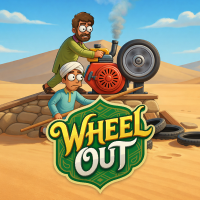
Wheel Out Game Icon

Wheel Out

Set your stake, press SPIN, and observe the wheel navigate the desert track automatically

AUTO
Resolution
INSTANT
Rounds
96.5%
Theoretical RTP
Fast-paced track game from INOUT GAMES Experience the Game

Track Element Categories

Every symbol on the desert path influences the running total in a distinct way

Linear Boosts

Incremental Adders

STEADY GAINS
+1, +2, +5, +10 LEARN MORE
  • Adds fixed values to the total
  • Builds consistent progress
  • Activates on wheel contact
View Details
Hazards & Penalties

Pigeon Obstacle

SEVERE PENALTY
/2 PIGEONS LEARN MORE
  • Cuts the running total by half
  • Strikes without warning
  • Cannot be manually avoided
Explore Track

How Wheel Out Operates After SPIN

Wheel Out delivers a straightforward instant-game structure that eliminates the complexity of manual decision-making during the round. The player begins by choosing a stake amount and, if desired, adjusting the visual speed of the presentation. Once the SPIN button is pressed, the wheel is propelled onto the desert track, and from that moment forward, every subsequent event unfolds automatically. There is no steering wheel to tilt left or right, no joystick to guide the trajectory, and no cash-out button to tap when the total looks favorable. The wheel follows its predetermined path, interacting with every symbol it encounters, until the round reaches a natural conclusion—either a safe landing that banks the final total or a terminal hazard that ends the sequence with a loss.

This automatic resolution model creates a unique rhythm. Players watch as the wheel rolls forward, striking fixed adders like +1, +2, +5, or +10, each of which contributes a steady increment to the running value displayed on screen. When the wheel crosses a multiplier zone marked x2, x3, x4, or x5, the accumulated total is instantly scaled upward, often transforming a modest run into a significant result. The excitement lies entirely in observation: because no manual input is possible after launch, every collision, every penalty, and every multiplier becomes a moment of pure anticipation. This design philosophy has resonated strongly with audiences in India and Pakistan, where the viral appeal of the format has driven widespread recognition.

Understanding that Wheel Out removes all post-launch control is fundamental. The speed setting chosen before SPIN affects only how quickly the visual sequence plays out on screen—it does not introduce steering or a manual exit option. The game is built for viewers who want fast, decisive rounds with no mid-action decisions, making it distinct from crash-style games that require players to time a manual cash-out before a multiplier collapses.

Game Specifications

Attribute Value
Developer INOUT GAMES
Game Type Instant Wheel-and-Track
Control Model Fully Automatic Post-Launch
Theoretical RTP 96.5%
Steering Not Available
Manual Cash-Out Not Available
Speed Selection Adjustable visual pacing
Platform Access Varies by operator

What the 96.5% RTP Figure Means

The 96.5% theoretical Return to Player statistic associated with Wheel Out is a critical piece of information, but it requires careful interpretation. This percentage does not describe what will happen in your next ten spins, nor does it promise that you will recover 96.5% of your stake during a single session. Instead, it represents a long-term mathematical model constructed by INOUT GAMES, calculated across millions of simulated automatic rounds. The RTP reflects the proportion of all stakes that the game's algorithm is designed to return to players over an extended period, assuming perfect statistical equilibrium. It is an architectural property of the game's design, not a session-level prediction.

In real play, Wheel Out exhibits short-term variance, meaning the actual outcomes of individual rounds can deviate wildly from the theoretical average. A player might experience a sequence of rounds where the wheel strikes a wall or plunges into a pit almost immediately, resulting in rapid losses. Alternatively, the automatic path might navigate through a fortunate combination of fixed adders and culminate in a high multiplier, delivering a result far above the stake. The track's design—with its mix of incremental bonuses, exponential multipliers, harsh penalties like the /2 Pigeons, and terminal hazards—ensures that short-term results are erratic and unpredictable.

The absence of manual cash-out further intensifies this volatility. Since the player cannot lock in a favorable intermediate total, the wheel remains exposed to every remaining hazard on the track until it either lands safely or hits a terminal obstacle. A strong running total can be halved by the Pigeon penalty just before the finish, or the Ladder Holder might rescue a doomed trajectory at the last second. The 96.5% RTP is a useful benchmark for understanding the game's structural fairness over the long haul, but it offers no insight into the outcome of your next spin or your next hour of play.

Key Mechanical Elements

Full Automatic Progression

After SPIN is pressed, the wheel travels without any player input. There is no steering and no option to stop early. The round resolves on its own, shifting the experience from active control to focused observation of the unfolding track events.

Incremental Adders

Symbols marked +1, +2, +5, and +10 are scattered along the track. Each time the wheel makes contact with one of these elements, the running total increases by the corresponding fixed amount. These adders form the backbone of steady progress during a round.

Multiplier Symbols

The track also contains multiplier zones labeled x2, x3, x4, and x5. When the wheel crosses one of these, the current running total is multiplied by the indicated factor. A well-timed multiplier can transform a modest accumulation into a substantial result, driving the short-term variance nature of the game.

Pigeon Hazard

The /2 Pigeons symbol is a mid-round penalty. If the wheel collides with this obstacle, the running total is immediately divided by two. This hazard can drastically reduce a promising total, adding a layer of risk that cannot be manually avoided once the round has started.

Walls and Pits

Certain track sections contain walls and pits that act as terminal hazards. If the wheel strikes a wall or falls into a pit, the round ends instantly, and the entire running total is forfeited. These elements represent the ultimate risk during the automatic travel phase.

Ladder Holder Save

The Ladder Holder is a special symbol that can rescue a failing run. If the wheel is heading toward a terminal hazard but encounters the Ladder Holder first, the element saves the current total and relaunches the wheel, offering a second chance within the same round.

Visual Theme and Cultural Context

Wheel Out's visual identity is rooted in a raw, desert-track aesthetic that distinguishes it from the brightly colored, neon-saturated interfaces common in many instant games. The game's popularity surged in India and Pakistan, where the concept of an automatic wheel launch across a rugged, sun-scorched landscape resonated strongly with mobile audiences. The design is deliberately minimalist: a clear trajectory line, stark symbols for adders and hazards, and a muted color palette that keeps the focus on the mechanical action rather than decorative flourishes. This visual restraint serves a functional purpose, ensuring that every collision with a +5 adder or a /2 Pigeons penalty registers immediately in the player's perception.

The presentation is optimized for portrait-mode mobile play, with all critical information—current total, stake, and speed setting—displayed in an uncluttered vertical layout. INOUT GAMES has designed the interface to eliminate distractions, reinforcing the game's core mechanic: you make one decision at the start, then you watch. The Petarda Crow, a chaotic hazard that causes visual disruption, and the rigid geometry of the walls create a tactile sense of danger, while the smooth arcs of successful multiplier hits provide satisfying visual feedback. This thematic cohesion between mechanics and presentation has been central to Wheel Out's viral appeal.

Round Structure and Timing

Pre-Round Setup

  • Choose your stake amount before launch
  • Optionally adjust the speed setting for visual pacing
  • Review your choices, as no changes are possible mid-round
  • Press SPIN to commit and initiate the automatic sequence

Watching the Track Resolve

  • The wheel launches and begins its automatic journey
  • Observe each collision with adders, multipliers, and penalties
  • React emotionally to the /2 Pigeons and other hazards
  • Wait for the final outcome: safe landing or terminal hazard

Developer Background

INOUT GAMES is credited as the developer behind Wheel Out. The studio's design philosophy centers on streamlined, observation-focused gameplay. By removing steering and manual cash-out mechanics, INOUT GAMES has created a format where the player's only active moment is the initial SPIN decision. The rest of the round unfolds automatically, with the running total responding instantly to every track element encountered.

Common Questions About Wheel Out

What happens after I press SPIN in Wheel Out?
Once you press SPIN, the wheel is launched onto the track and travels completely automatically. You cannot steer the wheel or manually cash out during the round. The sequence resolves on its own, ending with either a safe landing or a terminal hazard.
What does the 96.5% theoretical RTP represent?
The 96.5% RTP is a long-term statistical average calculated over millions of rounds. It indicates the proportion of total stakes the game is designed to return to players over an extended period. It does not predict the outcome of any individual round or session.
Which studio created Wheel Out?
Wheel Out was developed by INOUT GAMES.
How does the /2 Pigeons symbol affect my round?
If the wheel hits the /2 Pigeons symbol during its automatic travel, the current running total is instantly cut in half. This penalty cannot be avoided manually once the round has started.
Does the speed setting influence the result?
No. The speed setting controls only how fast the visual sequence plays out on your screen. It does not change the outcome, add steering, or introduce a manual cash-out option.
What occurs if the wheel collides with a wall?
Hitting a wall is a terminal event. The round ends immediately, the running total is lost, and the result for that spin is zero.

Ready to Watch the Wheel Roll?

Automatic track progression. 96.5% theoretical RTP. One-tap launch mechanics.

Start Playing

18+ only. Set limits and play responsibly.